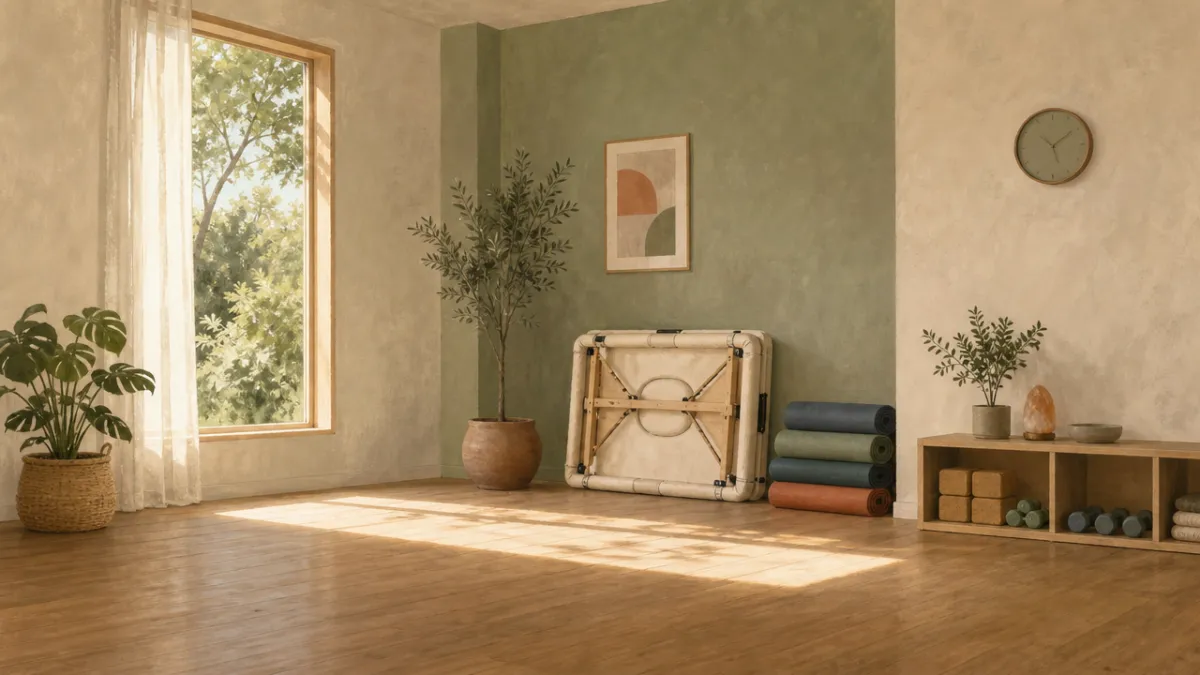
What does an empty hour actually cost you?
Prefer to listen? This article is also Episode 1 of Trimio Unlocked, the Trimio podcast.
You know the feeling of walking through your own space at eleven in the morning. Lights on, rent paid, nobody in it. Most owners have had that Tuesday afternoon, and most instructors have spent a Tuesday afternoon looking for exactly that room.
What most owners never do is work out what the hour is costing them. They know it is something. Few know it is the most expensive hour in the building.
This is the arithmetic that usually gets put off for years. It takes ten minutes and your own numbers.
Why the empty hour is the expensive one
Every studio, clinic, gym and hall has the same shape to its week. Full at six in the morning, full at six in the evening, quiet in between. That is not a failure of programming. Your clients have jobs.
The lease does not know that. Neither does the power bill, the insurance, the cleaning contract or the equipment finance. Those costs are fixed, and they are paid on every hour the doors could be open, whether anyone is inside or not.
So when a room is full, its share of the fixed cost is covered by the people in it. When the same room is empty, its share is still being paid, by you, out of the busy hours. The empty hour does not cost nothing. It costs exactly what the full hour costs, and it returns nothing against it.
That is the whole argument in one sentence: the empty hour is the expensive one. If that lands, the rest is mechanics.
How do you work out what an empty hour costs?
You need three numbers, and you already have them.
What the space costs you for a year. Rent, outgoings, power, insurance, cleaning, and any equipment finance tied to that room. Not wages, not marketing, not your time. Just the cost of the space existing.
How many hours a year it is available. Not the hours you run classes; the hours it could be used. Six in the morning to eight at night on weekdays is seventy hours a week, about 3,640 a year.
How many of those hours are earning. The sessions on the timetable that run with people in them.
Divide the first number by the second. That is what every hour costs you, used or not.
Here is a worked example, and it is an example, not your numbers and not a claim about anyone's studio. Say a single room costs $52,000 a year to occupy, all in. Available seventy hours a week, that room costs about $14.30 an hour. If thirty of those hours have paying sessions in them, forty hours a week are empty, and those forty hours are costing about $570 a week. Roughly $29,000 a year, on one room, for hours in which nothing is happening.
Your figures will be different. The structure does not change, and neither does what it tends to reveal: the quiet hours are usually the largest cost in the business not attached to any revenue.
If you would rather not do it by hand, the revenue calculator on our site runs the same sum with your inputs, and shows what those hours could be worth after Trimio's service fee. Could be worth, not will earn. What you earn depends on who books, and nobody honest can promise that.
Why the usual fixes cost more than they return
If you have owned a space for more than a year, you have already looked at this and put it down again. Not because you missed it, but because every fix had a cost bigger than the hour it was meant to rescue.
Hiring someone to run a midday class means wages whether it fills or not. You have moved the fixed cost from the room to the roster. A handshake sublet to an instructor you know means chasing rent from someone you cannot really manage, in a space you are still responsible for, with no record of who was in the building. Discounting the quiet hours trains your own clients to wait for the discount.
None of these are stupid ideas. Most owners have tried at least one. They are the rational responses to a room that could only ever be promised to one person, once. That constraint has kept studio hours empty for forty years, and it is a constraint of the tools, not of the owners.
What changes when the empty hour becomes inventory
The shift is a way of seeing the room. A quiet hour is not a cost you absorb because that is what the industry does. It is a unit of something you own, with a price on it, open to people you have chosen.
On Trimio, in the order it happens:
You list the hours you are not using, and set your rate. Your room, your hours, your hourly rate including GST. List Tuesday afternoons and nothing else if that suits. No minimum, no exclusivity, and you keep hiring the space out any other way you already do.
Instructors submit Offerings, and you decide who comes in. They see your rate before they submit anything. You talk privately in the app. Nobody teaches in your space without your yes, and you can revoke that approval at any time. How they get in is agreed between you in private messages; Trimio does not manage access. Nor does it vet instructors. Stripe identity checks confirm who a person is, not whether they are right for your space. That judgement stays with you.
More than one instructor can put a session over the same hour. An instructor creates an Offering, with their price and class size, and submits it to your open hours. A second instructor can do the same over the same hour. Nothing is locked in until a client books, and the first booking decides who teaches. You are not promising the room to anyone. You are letting people you have approved put a class on it and see if it fills.
The instructor sees the arithmetic before they commit. The app shows them your rate, the service fee, what they would keep, and how many clients they need to break even. If fewer book, they cover the difference. So the instructors who put sessions on your hours have already done the maths on your hour. You are not carrying the risk of an empty class.
You get paid when sessions run. Clients book and pay in the app. Your payout usually reaches your bank within two business days.
What it costs you
Hosts and instructors each pay one service fee on their own takings, made up of 13% of that revenue and $1.00. It covers every payment moving in and out, including your payout. No subscription, no listing fee, no lock-in.
On a $60 hourly rate: $60 is allocated to your room, the service fee on your side is $8.80, and $51.20 is paid to you.
If nobody books, you pay nothing. No session, no fee, no hosting charge.
If a client cancels inside 24 hours, they are charged and you are still paid. If an instructor cancels inside 24 hours, you are still paid. If you cancel a session with bookings on it, you cover the payment costs on those bookings, what it cost to take their payments and return them. The app shows you the exact amount before you confirm, and you are never liable for what the instructor would have earned.
What Trimio does not do
Three things you will not read here, because the market expects to hear them and they are not true yet.
Nobody will tell you how much you will earn. Any figure would be a guess dressed up as a promise.
Nobody will tell you instructors are lining up. Trimio is live across Australia and it is early. Whether there is an instructor near you with five people who would come on a Tuesday is a question the app can help you answer, not one anyone can answer for you.
And nobody will tell you that Trimio fills your hours. It does not. It gives you a way to price them, open them to people you approve, and let a client booking decide whether a class runs.
What can be said is that the app does the arithmetic the owner has never sat down and done, and shows it before anyone commits. In a small 2019 survey of facility owners, 65 of the 76 who answered said they had capacity to host more practitioners. Most had never put a number on what that capacity was costing them. If you have read this far, you now can.
The alternative is the one you already know. The Tuesday afternoon stays empty for another year, and the lease renews at a higher number.
Watch the free webinar
A free recorded session of about 30 minutes for people who own or run a studio, clinic, gym or hall. It walks through this arithmetic with real inputs and shows the app from the host side. Watch it as soon as you register, or pick a time that suits. Nothing to buy.
If a webinar is not your thing, run your numbers in the revenue calculator, or book a free 30-minute downtime audit and the Trimio team will do the arithmetic with you on your figures.
Questions owners ask
Do I have to be there when an instructor is using my space?
No. Supervising your space does not mean standing in it. You agree access privately with each instructor you approve, and you can see who is booked and when.
What if nobody books a session?
Nothing is charged. No service fee, no hosting fee. The instructor's Offering simply does not run.
Can I take back an approval?
Yes, at any time. Revoking approval removes that instructor's ability to put sessions over your hours.
Does Trimio find instructors for me?
No. Instructors find your listing in the app and submit an Offering to your open hours. You approve or decline each one. Trimio does not vet them for suitability and does not promise to fill your hours.
What does it cost if a session runs?
One service fee on your takings, made up of 13% of the session's revenue and $1.00. On a $60 hourly rate that is $8.80, and $51.20 is paid to you, usually within two business days.