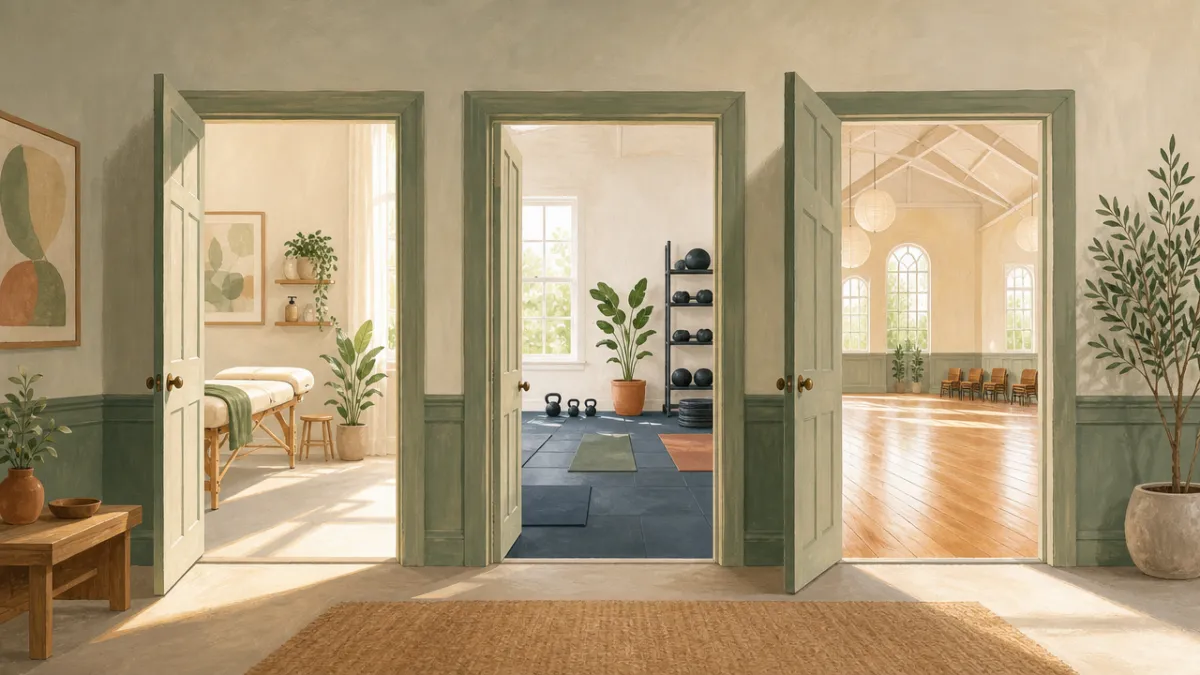
Where instructors run their own sessions
Prefer to listen? This article is also Episode 12 of Trimio Unlocked, the Trimio podcast.
The picture most instructors have of running their own session is a borrowed Pilates studio: someone else's Reformers, someone else's room, an hour on a quiet afternoon. That is one option, and a good one for equipment work. It is not the only one, and for many sessions it is not the best fit.
The space you need depends on the session you want to teach. A mat class for twelve does not need a room full of machines, and paying for one makes the arithmetic harder. A clinical session for three may be better in a treatment room than a studio. A seniors' class may belong in a hall with easy parking and step-free access.
This post goes through the kinds of space instructors run sessions in, what each tends to suit, and what to weigh when you choose. It describes types of space, not particular venues, and it does not promise any of them is listed near you. That is a question the app answers.
Start with the session, not the room
On Trimio, you describe your session before you look for a room: the kind of session, your price per client, your class size, and the time you need, including set-up and wrap-up. The app then only shows you rooms that suit that service, fit that class size, and whose hourly rate still lets your session break even.
So the first decision is not "which room" but "what exactly am I running". Be specific. "Reformer, four clients, 55 minutes" and "mat, twelve clients, 45 minutes" lead to very different rooms, and very different numbers.
The equipped studio
If your session needs Reformers, Cadillacs, chairs or other apparatus, an equipped Pilates or movement studio is usually the only realistic option. The equipment decides your class size, not the floor space, and the room's listing will say what is included.
Equipped studios tend to have higher hourly rates, which makes sense given what is in them. That matters most for small classes. A four-client Reformer session has to cover the room with four prices, so it is worth checking the break-even closely before you choose one.
The clinic room
Physiotherapy, osteopathy and exercise physiology practices often have a rehabilitation room or a larger treatment room that sits free for part of the week. Some have small equipment, some a few machines, some just floor and mats.
These rooms can suit small-group clinical or rehabilitation-focused sessions, pre- and post-natal classes, and one-to-one work. A clinic host is likely to ask closely about your qualifications and scope of practice before approving you, which is exactly what you would want if your clients have particular needs.
The gym floor or group fitness room
Group fitness rooms in gyms are often busy early and late and quieter in the middle of the day. They usually have a good floor, mirrors, sound and some equipment such as mats, bands or light weights.
They suit mat-based classes, strength and conditioning for small groups, barre, stretch and mobility sessions, and yoga. Check the listing for what equipment you may use, and ask the host what else will be happening in the building during your session.
The hall
Community halls, church halls, school halls and club rooms often have plenty of floor, few fixtures and lower hourly rates. They can suit larger mat classes, seniors' movement classes, community yoga, and anything where you bring your own kit.
The things to check are practical ones: capacity, flooring, heating and cooling, where you can store equipment, how you get in, and what your clients need to know about parking and access. A lower rate with more room can make a larger class work comfortably where a studio would not.
The treatment room or small studio
A single room in a wellness practice or a small studio can suit private sessions, duets and very small groups. The rate is often lower, which matters for one-to-one work, where one client's price has to cover the room and the fee on its own.
How to weigh one room against another
Once you have a few rooms that fit, three things usually decide it.
The break-even. The app shows it for each room before you choose, and it recalculates as you change your price, class size or the room. A cheaper room with enough space often beats a nicer one.
Where your clients are. The best room is one your clients will actually travel to, at a time they can make. A room ten minutes closer to where your list lives is worth more than a room with better lighting.
The host. Every host decides who teaches in their space, after talking with you privately in the app. A host who answers your questions clearly, agrees access simply and is happy with your session is worth a lot.
Different times on the same Offering can sit in different rooms. Your Wednesday morning might suit a clinic room near your weekday clients, your Saturday a hall near your weekend ones.
What it costs, wherever you teach
The sum is the same in every kind of space. The hosting fee is the room's hourly rate for all the time your session needs. One service fee comes off your own takings, made up of 13% of that revenue and $1.00. If what clients pay does not cover both, you pay the difference, the Hosting Shortfall Fee, to your card. If nobody books, nothing runs and nothing is charged. For every side of the money, see who books, who pays, who gets paid.
What Trimio does not do
Trimio does not guarantee a room near you. It is live across Australia and it is early. Whether a space where you teach is listed is a question the app answers. If it is quiet where you are, the most useful thing you can do is ask a studio, clinic, gym or hall you already know to list its empty hours, because instructors cannot use a room that is not listed. Telling us where you teach is what opens it up, because that is where we go looking for hosts next.
Tell us where you teach
If there is no room near you yet, or no room that suits your session, tell us where you teach and what kind of space you need.
Questions instructors ask
Do I have to teach in a Pilates studio?
No. Studios, clinics, gyms, halls and treatment rooms can all be listed, and each room shows the services it suits, its capacity and its equipment.
How does the app decide which rooms to show me?
It shows rooms that suit your service, fit your class size, and whose hourly rate still lets your session break even.
Can I run the same session in more than one space?
Yes. Different times on the same Offering can be covered by different rooms, each approved by its own host.
Is a cheaper room always better?
Not always, but the break-even matters most. Compare rooms on the break-even, on where your clients are, and on the host.
What if there is no suitable space near me?
Ask a space you already know to list its quiet hours, and tell us where you teach so we can look for hosts nearby.